
OUR TACTICS
A powerful, symbiotic machine for policy change.
We use the three interconnected tactics of Research, Advocate, and Activate. We drive high-impact community health system design with those responsible for CHW policymaking, financing, and implementation.
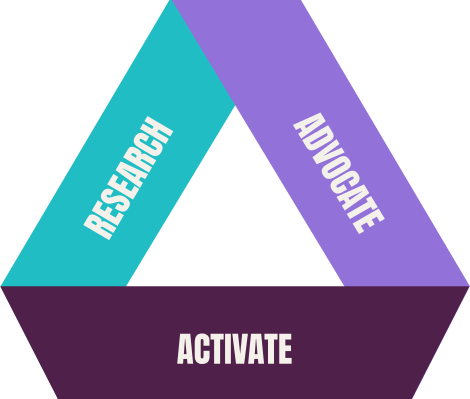

RESEARCH
We equip international norm setters with evidence to create proCHW guidelines.
- Publish joint studies
- Provide technical expertise for proCHW guidelines
- Distribute Research Round-Up

ADVOCATE
We influence global financing institutions to increase proCHW funding.
- Build stakeholder awareness and cultivate proCHE champions
- Track and affect investments in proCHWs
- Drive uptake of proCHW priorities amongst global norm setters and funders

ACTIVATE
We mobilize in-country networks to win national proCHW policy.
- Train and connect CHW Advocates with opportunities for action
- Track and affect national proCHW policy change
- Seed national NGO coalitions and CHW associations
CHAMPIONS OF THE HEALTH SYSTEM
Community health workers have been a global cornerstone of primary healthcare for a century. 70% are women. Yet professional CHWs remain the exception, not the norm.
CHWs are essential to realizing a first-class health system worldwide. And central to pandemic preparedness, prevention, and response. proCHWs are the most powerful force for achieving health for all. The proCHW model is remarkably simple, but the impact is immense. Now, governments have an opportunity to institutionalize this critical cadre of the health workforce.

PROFESSIONAL, DEFINED
Eight proCHW best practices.
These best practices drive results but are currently rare. So we’ll crusade until they’re not.
1
Accredited
Assess the health knowledge and competencies of CHWs to ensure minimum standards are met before carrying out work.
2
Accessible
Avoid point-of-care user fees when possible to improve accessibility, timeliness, and equity of care.
3
Proactive
Conduct disease surveillance by going door-to-door to find sick patients and teach them how to identify danger signs, then quickly contact a CHW.
4
Continuously trained
Make continuing medical education available to and required of CHWs through modular delivery or another type of in-service learning.
5
Supported by a dedicated supervisor
Provide CHWs with a dedicated supervisor to evaluate the patient experience and give 1:1 coaching on a frequent, regular basis.
6
Paid
Compensate CHWs financially at a rate that’s competitive relative to the respective market.
7
INTEGRATED INTO A ROBUST HEALTH SYSTEM
Invest in increasing the capacity, accessibility, and quality of the primary healthcare facilities, providers, and pharmacies to which CHWs link.
8
Part of data feedback loops
Collect data via CHWs, report it to public sector monitoring and evaluation systems, and train CHWs to use it to improve programs and performance.
Or in summary, professional means:
salaried, skilled, supervised, and supplied.
